

Videos
TUDAV Promotional video
Bycatch of Cartilaginous Fishes in Turkish Waters
Jellyfish bloom – Bridge BS
What is the stony coral? Cladocora caespitosa
Mediterranean Monk Seals of Gökçeada Island
https://youtu.be/oNF6_OUfLdc
Current System Modelling of Turkish Seas
Mediterranean, How Generous You Are
Plastics do not belong in the ocean!
Joint Press Release – Over 5 Countries, A Single Purpose

Over 5 countries, a single purpose: Accurate scientific data on the distribution/abundance of BS cetacean populations and on the by catch pressure
The greatest issue concerning the cetacean populations is closer to being solved through an effective and complex project, entitled ”Support MSFD implementation in the Black Sea through establishing a regional monitoring system of cetaceans (D1) and noise monitoring (D11) for achieving GES”- CeNoBS. The kick off meeting of the project took place in Bruxelles, last week and gathered partners and specialists from over 5 countries. The project is Co-funded by European Union thought European Commission Directorate-General Environment grant.
Specialists from Bulgaria, Monaco, Romania, Ukraine and Turkey gathered in Bruxelles last week for the kick off meeting on CeNoBS project- ”Support MSFD implementation in the Black Sea through establishing a regional monitoring system of cetaceans (D1) and noise monitoring (D11) for achieving Good Environmental Status- GES”. The kick off meeting established the grounds for the project, the objectives, specific activities and means of effective communication between the partners of the project. In addition, it was a great opportunity for the partners to exchange information on the local or national issues on cetacean distribution.
During the meeting, several presentations emphasized the importance of the project, together with the importance of having a good and effective collaboration.
For the next 24 months, all partners will collaborate to create studies on the matter and will participate at specific workshops and activities, in order to achieve the project`s objectives.
Some of the most important project activities are:
- Noise monitoring The pilot actions for noise monitoring will allow to test methodologies applied in other marine areas and to define proposals and recommendations for D11 noise monitoring in the Black Sea.
- Bycatch monitoring Pilot activities on cetaceans by-catch monitoring will be implemented. Data will be collected though port questionnaires and onboard observers. Postmortem examination of cetacean carcasses stranded ashore will be conducted as an independent estimation of bycatch rate with special focus of the IUU fishing.
- Aerial surveys- aimed at collecting visual sightings of Black Sea cetaceans. The aerial survey will be conducted in both territorial waters and exclusive economical zones of Romania, Bulgaria, Turkey and Ukraine in the Black Sea.
The final project meeting will take place at Bruxelles. There will be several events in the frame of which the CeNoBS project will be promoted, like EMD (European Maritime Day), ACCOBAMS Meeting of the Parties side event, Black Sea Commission meeting etc.
The CONTEXT
The lack of background data on the distribution/abundance of BS cetacean populations and on the by catch pressure, and the lack of national expertise to implement effective noise monitoring is a great issue that regards all of the European coastline countries.
Marine Strategy Framework Directive (MSFD) represents the pillar of European Union, which aim is “Good Environmental Status” (GES) in European marine waters by 2020. The Black Sea is one of the most vulnerable regional seas and Romania and Bulgaria are the European Member States responsible for implementation of MSFD, in close collaboration with the other non EU countries.
The PROJECT
Support MSFD implementation in the Black Sea through establishing a regional monitoring system of cetaceans (D1) and noise monitoring (D11) for achieving GES”- CeNoBS is a 24 months project , co-funded by by European Union thought European Commission Directorate-General Environment grant. CeNoBS is a multipartners project coordinated by Mare Nostrum NGO/Romania, and aims to improve second cycle of MSFD implementation for 2 essential descriptors:
Descriptor 1 – marine mammals/cetaceans and Descriptor 11- noise in the Black Sea, by achieving greater consistency and coherence in determining, assessing and achieving good environmental status (GES).
The proposed activities will fill the lack of background data on the distribution/abundance of BS cetacean populations and on bycatch pressure and the lack of national expertise to implement effective noise monitoring. The main objectives are to assess D1 cetacean related criteria and establishment of thresholds values, to assess and support the development of D11 monitoring in the Black Sea and to enhance coordination among the Black Sea region through the dissemination of the project activities, results and outcomes.
The PARTNERS
For this effort, partners from 2 EU member states (Romania and Bulgaria) and Third Countries: Ukraine, Monaco and Turkey. Both competent authorities from the EU MS are partners of the project, Romanian Ministry of Waters and Forests and Bulgarian Black Sea Basin Directorate together with the responsible of the scientific implementation of the MSFD, Institute of Oceanology – Bulgarian Academy of Sciences IO-BAS and National Institute for Marine Research and Development “Grigore Antipa” – NIMRD. Green Balkans NGO (Bulgaria) and Mare Nostrum NGO (Romania) support these institutes in the implementation of D1 cetaceans monitoring activities. And partners from third countries involved in the project activities are Ukrainian Scientific Centre of the Ecology of Sea (UkrSECS), Turkish Marine Research Foundation (TUDAV), Karadeniz Technical University (KTU) and Permanent Secretariat of the Agreement on the Conservation of Cetaceans of the Black Sea, Mediterranean Sea and contiguous Atlantic Area (ACCOBAMS).
”Support MSFD implementation in the Black Sea through establishing a regional monitoring system of cetaceans (D1) and noise monitoring (D11) for achieving GES”- CeNoBs is co-funded by the European Union thought European Commission Directorate-General Environment grant. Project value: 548.285 euro


World Oceans Day Message from UN to TUDAV
On the Beach
An Unusual Duo
Lionfish in the Mediterranean
Joint Press Release – Mediterranean Symposia on Marine Key Habitats and Non-indigenous Species
Mediterranean symposia on marine key habitats and non-indigenous species: A scientific gathering to share knowledge and foster marine biodiversity conservation
Scientists and researchers from all over the Mediterranean will meet in Antalya from 14 to 18 January 2019 to exchange knowledge on marine biodiversity conservation and enhance cooperation to achieve the good environmental status of the Mediterranean Sea.

Antalya, Turkey, 14 January 2019 – Improving the quality of the marine and coastal environment in the Mediterranean remains the priority objective of the Mediterranean Action Plan (MAP), a UN Environment regional seas programme. Improving and sharing knowledge on biodiversity, is a key activity to achieve this objective.
In this context, the Specially Protected Areas Regional Activity Centre (SPA/RAC), the Mediterranean biodiversity centre of MAP, is organizing the Mediterranean symposia on marine key habitats and non-indigenous species, in collaboration with the Turkish Ministry of Environment and Urbanisation and the Turkish Marine Research Foundation (TUDAV), as follows:
- 6th Mediterranean symposium on marine vegetation (from 14 to 15 January 2019)
- 3rd Mediterranean symposium on the conservation of coralligenous and other calcareous bio-concretions (from 15 to 16 January 2019)
- 2nd Mediterranean symposium on the conservation of the dark habitats (16 January 2019)
- 1st Mediterranean symposium on the non-indigenous species (from 17 to 18 January 2019)
Please click to press release


Gökçeada Marine Underwater Park – Avrupa’dan Anadolu’ya Doğal Lezzetlerin İzinde
Gökçeada Marine Underwater Park
Turkish Antarctic Research Expedition 2016
Joint Press Release – Project of collaboration for the protection of the Black Sea ANEMONE

Constanța,19 October 2018
PRESS RELEASE
Kick-Off Meeting of a new European Project: Collaboration for the protection of the Black Sea
ANEMONE: Assessing the vulnerability of the Black Sea marine ecosystem to human pressures
During 22-23 October 2018, the partners in the ANEMONE Project (Assessing the vulnerability of the Black Sea marine ecosystem to human pressures) are convening in Constanta for the Kick-Off Meeting.
The ANEMONE Project aims to deliver, through collaborative efforts among partners, a common strategy related to the Joint Monitoring of the Black Sea, using the most adequate common agreed assessment criteria and indicators, in order to assess the status of the Black Sea, as a basis for further actions.
The Project aims at establishing enhanced cross-border contacts within the Black Sea Basin (scientists and stakeholders networking, forums, and establishment of lasting partnership), enhanced knowledge and skills (the exchange of experience and good practices, innovation, harmonized methodologies, and joint research), as well as concrete and visible outputs (pilot projects, shared tools, online open-access resources).
The project is coordinated by the National Institute for Marine Research and Development “Grigore Antipa” (NIMRD) (Romania), with partners from Romania (Mare Nostrum Non-Governmental Organization), Bulgaria (Institute of Oceanology – Bulgarian Academy of Sciences – IO-BAS), Turkey (Scientific and Technological Research Council of Turkey – Marmara Research Center – TUBITAK-MAM – and Turkish Marine Research Foundation – TUDAV) and Ukraine (Ukrainian Scientific Center of Ecology of Sea – UkrSCES).
ANEMONE is funded through the Joint Operational Programme Black Sea Basin 2014-2020, Programme priority: 2. Promote coordination of environmental protection and joint reduction of marine litter in the Black Sea Basin, Programme priority specific objective: 2.1. Improve joint environmental monitoring, and will be implemented during 26.07.2018 – 25.11.2020.
The PRESS CONFERENCE will be held on Tuesday, 23 October, starting at 11:00, IBIS HOTEL, Constanta, Amphitheatre Hall.
Contact:
Project Coordinator: Dr. Laura Boicenco, NIMRD “Grigore Antipa“, e-mail: lboicenco(@)alpha.rmri.ro
Dr. Magda Nenciu, tel. 0766.734.030, e-mail: mnenciu(@)alpha.rmri.ro,
Dr. Mariana Golumbeanu, e-mail: golumbeanum(@)gmail.com
A Whale of a Road (Minke’s Way)
A Story of an Invasive Alien Species, Rapana venosa, in the Black Sea
We Need More MPA’s
“We Need More MPAs” is produced by TUDAV to raise awareness on the importance of marine protected areas. In “We Need More MPAs” the richness of the Mediterranean biodiversity and the dangers it faces are mentioned. Also representatives and scientists from Mediterranean research institutes made brief statements.
Joint Press Release – Toxic and Poisonous Alien Species occurring in the Mediterranean Sea
About 1000 alien species have been reported in the Mediterranean Sea, more by far than in other European seas. A small number of the marine invasive alien species induce human health impacts, being venomous and poisonous. Recently, the news of the death of three Libyan fishers who consumed the poisonous silver-cheeked toadfish, have drawn the attention of the media and the public. As marine scientists, engaged in the study of alien species, we wish to provide accurate information concerning these new health hazards.
Among the alien species recorded in the Mediterranean Sea, ten are noted as human health hazards – seven fish, a sea urchin, a scyphozoan jellyfish and a hydrozoan. Most have either been post-millennial records or have greatly increased their spread in the last decade. All originate in the Indian Ocean or the Indo-west Pacific Ocean and are considered to have entered the Mediterranean through the Suez Canal. Four species are confined to the Levant and Tunisia, and even for those recorded further west and north (e.g. Silver-cheeked toadfish Lagocephalus sceleratus, Dusky spinefoot Siganus luridus, Marbled spinefoot Siganus rivulatus, Nomadic jellyfish Rhopilema nomadica and Lionfish Pterois miles), the largest populations occur in the Levant. With rising temperature, it is likely these thermophilic species will expand their range.
Please click to open press release 
CoCoNET Documentary Film
As a part of the outreach program, we have produced a 30-min documentary film on CoCoNet, directed by Roberto Rinaldi. It features Marine Protected Areas, ecosystem functioning, and offshore wind farms, with beautiful and colorful footages of both the Mediterranean and Black Sea. Please take a look and show it for various outreach and dissemination activities.
Press Release – Researchers, NGOs and fishermen, hand in hand to reduce bycatch in the Mediterranean Sea
12.07.2018
The inception workshop on the bycatch project was organized by Turkish Marine Research Foundation in Taksim, Istanbul, on July 9th 2018. To understand the level of bycatch in the Mediterranean Sea and to test the mitigation measures, field studies will be conducted by Doga Dernegi, DEKAMER, WWF Turkey and TUDAV.
Bycatch is the accidental catch of no-target species in fishing activities. Every year thousands of vulnerable species, such as dolphins, turtles, birds, sharks and rays, are entangled in fishing nets, most of which result in death. It is one of the most serious problems concerning the survival of these species.
To understand the level of bycatch in the Mediterranean Sea and to test the mitigation measures, MAVA Foundation has decided to support the project called « Understanding Mediterranean multi-taxa ‘bycatch’ of vulnerable species and testing mitigation- a collaborative approach » in three project areas, Morocco, Tunisia and Turkey, under the leadership of FAO GFCM, in the partnership with Birdlife International, ACCOBAMS, UNEP-MAP, IUCN and MEDASSET. In Turkey the surveys will be conducted with the collaboration of TUDAV, DEKAMER, Doga Dernegi and WWF Turkey.
One of the partners of the project, ACCOBAMS, is the regional agreement on the conservation of the cetaceans (whales and dolphins) in the Mediterranean and Black Seas. TUDAV has been their partner for more than 10 years. In this framework, an inception workshop for this bycatch project was organized by TUDAV in Taksim, Istanbul, on 9 July 2018. Thirty-six people from universities, NGOs, Coast Guard, and international organizations participated the workshop to discuss how we can achieve the goal of the project.
The bycatch data will be collected by observers sent to fishing vessels as well as interviewing fishermen in selected ports. There will be a training activity, workshops with fishermen, and also testing the possible mitigation measures during fishing activities.
Reducing bycatch is important for sustainable fisheries. Without these vulnerable megafauna, such as turtles and dolphins, our marine ecosystem do not function in a healthy way. We expect to cooperate with fishers for achieving this goal. The project will continue until 2020 when we can share our experience to protect precious marine life in our seas.


Press Release – Bloom of Emiliania huxleyi
A SEASONAL PHYTOPLANKTON BLOOM IMPACTING THE TRANSPERANCY OF THE BLACK, MARMARA AND AEGEAN SEAS
A bloom made by cocolithophore, a phytoplankton species, Emiliania huxleyi this year has made long and significant effects on the Black Sea and the adjascent seas, such as the Marmara and Aegean Sea. This phytoplankton bloom is a natural seasonal phenomenon but this year’s lasts longer
Please click to press release.
The satellite images from NASA Worldview are below.


Yeşil Doğa, CNN Türk, 6 Aralık 2014 TUDAV-MARLISCO
Press Release-First Turkish Deep Sea Workshop
FIRST TURKISH DEEP SEA WORKSHOP
19 June 2017, Gökçeada, Turkey
The First National Deep Sea Workshop was held in Gökçeada Island, Turkey, located in the North Aegean Sea, by Marine Biology Department, Faculty of Fisheries, and Istanbul University with the sponsorship of the Turkish Marine Research Foundation (TUDAV). Approximately 30 researchers from 11 institutions attended and madesignificant contribution for this workshop.
Please click to Press Release.

Cetacean Stranding Research Survey 2003
Dolphins of the Bosphorus
Doğanın Bekçileri: Türkiye
Preserving the Marine Environment of Oludeniz Lagoon
TUDAV 20th Anniversary Science and Press Awards
26 Kasım 2017 tarihinde vakfımızın 20. yılında Bilim ve Basın Ödülleri verildi. Ödül alan hocalarımız ve basın mensupları; Ali Kurumahmut, Prof.Dr. Emin Özsoy, Prof.Dr. Gökhan Halıcı, Prof.Dr.Maide Çimşit, Prof.Dr.Murat Sezgin, Doç. Dr. Mustafa Yücel, Handan Erdoğan, Gökhan Karakaş ve Serkan Tahmaz oldu.


Press Release – On deliberate killing of the Mediterranean Monk Seal in Greece
Statement on the deliberate killing of the Mediterranean Monk Seal Monachus monachus (Hermann, 1779) on the Samos Island, Greece
According to ‘www.samostimes.gr’ on May 24, 2017, a female adult monk seal was found dead in the southwest coast of Samos Island, Greece, on May 21, 2017. Evidences of deliberate killing were found by the researchers of the Archipelagos Institute of Marine Conservation.

Since Mediterranean monk seals are sedentary animals, the individuals can be recognized by the local people. The inhabitants of Samos also nicknamed the monk seal living in their region as “Argiro”. The researchers reported the possibility of the dead individual unfortunately was “Argiro” and stated that in any case, be it a famous or an unknown seal, the murder is equally despicable.
Deliberate killing is one of the main reasons for the decline of the monk seal population. It was reported that a half of the mortalities observed during 1986˗1996 were due to deliberate killing in Turkey. One of the most recent victims was reported in 2013, a seal called “Duman” (which means “Smoke” in Turkish) by local people in Antalya. His assailant has not yet been apprehended. Since Turkey and Greece inhabit the biggest population in the Mediterranean Sea, their responsibilities are huge for the survival of the Mediterranean monk seals and their cooperation is essential. Once again, we assert that guns have no place in fishing boats and demand all guns, firearms and shotguns alike be banned immediately!
These cases show that the state authorities, universities and NGOs should make stronger conservation action plans with common efforts. These plans must include precautions against deliberate killings, rescue plans for stranding animals and awareness raising programs for local people, to be implemented fully throughout all Turkish and Greek coastal areas.
About the Mediterranean monk seal, Monachus monachus (Hermann, 1779)
The Mediterranean monk seal, Monachus monachus (Hermann, 1779), is Europe’s most endangered marine mammal and it is protected by the Barcelona Convention (Fourth protocol species), Bern Convention (Appendix II), Biodiversity Convention (Eligible species), Bonn Convention (Appendix I and II) as well as CITES (Appendix I). M. monachus is also listed in Red List of IUCN as endangered status (IUCN 2016). It is estimated that 350-400 individuals live in the coasts of Turkey and Greece. Fishery interaction is a very common cause for adult monk seals mortality. Fishermen and fish farmers use lights, feeding with pesticide˗injected fish, noise generation, warning and direct shots with rifles and physical exclusion to keep seals away from the cages and nets.
Please report your observations…
Mitigating negative interactions between fishermen and seals and habitat protection are the main conservation priorities for the monk seals. Furthermore, scientific research and monitoring programs together with the public awareness campaigns are vital for the protection of the population.
If you see an individual of the Mediterranean Monk Seal, please send a message (preferably with a photo) to or call TUDAV and help the protection of this iconic animal of the Mediterranean Sea.
Tel: 0216 4240772
Press Release – Our Stolen Future by Illegal, Unreported and Unregulated Fishing in the World Ocean

Fishing stocks in world oceans are currently diminishing mainly due to overfishing, pollution, and coastal degradation. Climate change accelerates these damages in some areas. According to the recent FAO report, 80 % of the global fish resources are totally exploited, 18% are moderately exploited and only the rest 2 % are stable. These figures terrify all of us because humankind needs more and more food to support ever-increasing population as we have been dependent on ocean resources very substantially since antiquity.
On top of that, the world oceans have been recently facing another type of human-induced threats: lllegal, Unreported and Unregulated (IUU) fishing. Illegal fishing takes place when fishing is operated against law, such as fishing in forbidden areas/seasons, catching protected species of high commercial value as well as undersized fish. Unreported fishing is the fishing unreported or wrongly reported to authorities. Unregulated fishing is normally the fishing with vessels without any nationality or belonging to a country which is not a party to regional fisheries agreement. Thus, IUU fishing combines all these three activities. IUU fishing occurs in both territorial and high seas, carried out by all types of fishing vessel and fishing gear, regardless of size, flag, origin and registration in the oceans and seas all over the world.
It is estimated that minimum 11 million tons of fish is illegally and unreportedly caught annually. This is worth minimum 10 billion USD worldwide. In the developing countries of West Africa, at least 40% of fish caught is illegal with the estimated cost around 1.2 billion USD.
According to CCAMLR (Commission for the Conservation of Antarctic Marine Living Resources) report, even around the Antarctic, which is a unique pristine marine ecosystem on the planet, IUU fishing has been spotted. Patagonian toothfish is illegally caught by some nations ignoring the fact that it is an important food for seals, whales, dolphins and many other living creatures. In the Black Sea, sturgeons have been both overexploited and poached mainly for their caviar. It is now forbidden to catch them anymore, although it is too late as so few of them left yet to survive in the Black Sea. Some other targeted fish species of IUU fishing are bluefin tuna and swordfish in the Mediterranean Sea.
In addition, IUU fishing cause several threats in a manner of sustainability of fishing resources, conflicts between artisanal and industrial fisheries, damaging marine environment and causing also unfair competition, tax crime which leads to loss of revenues for states and more importantly loss of biological diversity in coastal and marine areas due to catch of non-target species such as sea birds, cetaceans, turtles and other non-commercial but ecological key species.
The main cause of this kind of fishing is due to weak governance framework, lack of trained staff and weak enforcement of laws, all of which IUU operators take advantage of, mainly in developing countries. Moreover, many crimes occur such as corrupting officials to issue license, to permit illegal landing of catches, to evade port state controls. While illegal fishing is against national laws or international obligations, the fight against such practices requires the engagement of state administrations, fisheries industries, NGOs and consumers.
Global seafood traceability and monitoring ‘from net to plates’ has also crucial importance to fight this threat and consumers should be made aware from where and how fish comes to their table. Even though the initiatives to combat IUU fishing have increased within the past 10 years, such effort is far from a success story yet. Nevertheless, UN General Assembly (UNGA) Resolutions 67/79 and 68/71 highlighted that IUU fishing remains one of the greatest threats to fish stocks and marine ecosystems and continues to have serious and major implications for the conservation and management of ocean resources.
Moreover, the FAO’s International Plan of Action to Prevent, Deter and Eliminate Illegal, Unreported and Unregulated Fishing call all states to comply fully with all existing obligations to combat such fishing and urgently to take all necessary steps to implement them. This plan also includes monitoring and surveillance of fishing vessels with systems like Vessel Monitoring System (VMS) and Automatic Identification System (AIS) to detect illegal operations and fishing grounds. Besides, preparing a national action plan, including capacity building for local authorities, is homework for the states.
To raise public awareness on IUU fishing issues, General Fisheries Commission for the Mediterranean Sea (GFCM) and Ministerial Conference on Fisheries Cooperation Among African States Bordering the Atlantic Ocean (ATLAFCO), both under the FAO umbrella, initiated the declaration of an international day for fighting against IUU fishing. This initiative may be a chance for zero tolerance of the IUU fishing practices in the Mediterranean Basin and East African Seas and others.
Finally, international cooperation and concerted actions are needed to secure global food security since the world population is increasing and there will be more protein demands continuously. It’s time to fill all loopholes to remove operational barriers for effective regional/global cooperation in combatting fishery crimes. We have to act together against IUU fishing in all oceans and seas for sustainable use of marine resources, not to let future stolen for our children….
TV5 Thalassa Istanbul part
(Fransızca)
TUDAV Leaving Marks in the Water 2009 Awards
Leaving Marks in the Water 2009 awards were announced in the 29th of September in 2009 during the National Water Days 2009 Symposium which is organized by TUDAV and Fishery Faculty of Firat University
Prof. Dr. İbrahim OKUMUŞ
He is considered worthy for this 2009 award, owing to his illuminative studies to the next generations as well as his work on improving the Aquaculture and Fishery Sector. He was a lecturer and a vice rector in Rize University
Prof. Dr. Ercan SARIHAN
He was a lecturer and retired in the Fishery Department of Cukurova University. He is considered worthy for this award due to his works on the development of Limnology Science in Turkey as well as his illuminative studies for the next generations.
Prof. Dr. Ayşe BOŞGELMEZ
She is a lecturer in the Science Faculty of Hacettepe University. She is considered worthy for this award due to her work on vectorial infections in the water as well as her illuminative studies for the next generations.
Press Release – Warning for Jellyfish in the Mediterranean Sea!
WARNING FOR JELLYFISH IN THE MEDITERRANEAN SEA!

The migratory jellyfish Rhopilema nomadica has entered the Mediterranean through the Suez Canal in the late 1970’s and rapidly expanded in the central and western Mediterranean. It is already known from Israel, Egypt, Turkey, Lebanon, Cyprus, Greece, Malta, Tunisia and Italy so far. This year, there was an exceptional increase in jellyfish in February on the Eastern Mediterranean coasts. The migratory jellyfish Rhopilema nomadica was first seen in the Lebanese coast and then in the Turkish coast after a week. First it was observed in the eastern coasts of Turkey, in the Gulfs of İskenderun and Mersin, then in the Gulf of Antalya, and sailors and fishermen reported many records. Observations with varying frequency in March continued in April. Especially, it was reported mainly from the sea and coasts of Antalya. Rhopilema nomadica previously increased in Antalya in 2009 and 2010 and created adverse effects. In the Mediterranean, the increase in the abundance of jellyfish in this measure was experienced in late spring and summer in the previous years. With increasing sea water temperatures, the jelly increase started at the end of winter and is likely to increase further in the coming days.
Please be careful … Avoid Contact
Due to the presence of nematocytes (cnidocyte) when contacted to the jellyfish, clinical effects can be seen such as inflammation, pruritus, red & irritated marks on the skin and swelling.

“The swimmers, divers and amateur and professional fishermen must be careful and avoid contact to the jellyfish. In addition, more serious clinical cases can be seen in allergic people. Especially children should not touch to the stranded jellyfish and if they come into contact, they should not touch to other parts of their body and eyes. In case of contact with jellyfish, the tentacles stay attached to the skin and activated nematocysts initiate burning and itching. The itching then leaves its place to pain and redness. The nematocysts are sensitive to osmotic changes like fresh water application and cause further nematocyst discharge. So, it is recommended to use only seawater or salty water, ammonia or vinegar to wash the contacted area. Get medical care if you are experiencing any symptoms worse than skin irritation or have trouble breathing.”
Please report your observations…
Rhopilema nomadica entered the Mediterranean Sea via the Suez Canal and poses a threat to fisheries, tourism and human health in the eastern Mediterranean Sea. It is very important to establish monitoring programs in order to reduce the negative effects of the jellyfish.
If you see jellyfishes, please send a message (preferably with a picture) to tudav(at)tudav.org or call TUDAV (Tel: 0216 4240772)
About Rhopilema nomadica

It has a nearly spherical umbrella. It has no marginal tentacles. The nematocysts are found on the oral arms and the edge of the umbrella. The umbrella is pale blue with a diameter of 90 cm and weight of 10 kg. It is a “Lessepsian” species that entered from the Red Sea to the Mediterranean Sea. It feeds on planktons. It has a high reproductive potential since it can reproduce both sexual and asexual. Therefore, in short periods and especially from June to September, it can be seen more often and creates potential danger for swimmers, fishermen and divers.
http://www.yayakarsa.org/index.php/en/bu-canl-lara-dikkat/deniz-anas-tuerleri/39-rhopilema-nomadica
Photos: Dr. Elif ÖZGÜR ÖZBEK
Sandbar Sharks at Boncuk Bay (Gökova Bay – Turkey)
Mutlu Payaslıoğlu
There hasn’t been any award given for 2008
There hasn’t been any award given for 2008
Press Release – Sharks, Rays, Skates Should Be Protected
Threatened species of sharks, rays and skates should be protected:
The National Cartilaginous Fish Conservation Action Plan has been published!
Turkish Marine Research Foundation (TUDAV) has publicly shared the National Cartilaginous Fish Conservation Action Plan for threatened species of sharks, rays and skates. The proposed action plan also suggests the protection of the threatened manta species whose catch have created great public reaction, recently.
On March 11, 2017, according to the news serviced by Anadolu Agency, thirty individuals of Mobula sp. were captured off the Mediterranean Sea and landed in the Izmir Harbor aiming to sell the fish to Greece by a dealer. On March 14, 2017, according to the news serviced by Ihlas News Agency (IHA), fourteen of them were sold to a fisherman in Istanbul for exhibition.
Fishing, landing, display and/or trade of this fish are restricted by international treaties that Turkey is party to. However, unfortunately the regulation was not included in the Notifications of the Ministry of Food, Agriculture and Livestock of Turkish Republic regulating the Commercial (No 4/1) and Amateur (No. 4/2) Fisheries (No: 2016/35, 36), so the fishermen does not aware of the restriction and the protection status of the species.
The Manta individuals were caught as by-catch by a purse seiner targeting a commercially high-value fish, such as tuna. Although their low commercial value, fisherman still prefer to market the mantas when caught, instead of releasing. Although the studies on the survival rate of post-released individuals are very scarce, the current studies indicate that handling, boarding or removing fish from the water greatly decrease the survival rate; however releasing them directly from the brailer of the purse seine is considered as the best practice.
The incident regarding the catch, sale and display of the manta individuals caused a great reaction of the public, the national and international NGOs and concerned academicians. Turkish Marine Research Foundation (TUDAV) has been following up the incident since the first day and has spent intensive efforts to inform, act on and cooperate with all relevant institutions. However, no results could be obtained due to the indifference and insensitivity of the related institutions.
One day before this sad incident, on March 10, to form the National Cartilaginous Fish Conservation Action Plan, our foundation organized a day-long workshop with the participation of 5 universities, 4 NGO representatives, an expert from the related ministry, a municipal representative an a fisherman who is the head of a fishing co-operative. The restriction of the catch of twelve cartilaginous species is proposed in the draft of the National Action Plan in addition to the five species that already takes part in the notifications regulating the commercial and amateur fisheries. The action plan can be accessed from the link.
In spite of the insensitivity of the relevant institutions, it is evident that the reaction of the public has created awareness for the protection of the cartilaginous fish. Last year, TUDAV suggested the restriction of the catch of the threatened cartilaginous species to enter to the notifications of fisheries; but unfortunately rejected for all except for one species. TUDAV will continue to follow the actions that should be taken by the relevant institutions and steps taken to eliminate legal gaps at the national level. To follow-up at the international level, TUDAV will also support newly released IUCN Global Conservation Strategy for Devil and Manta Rays. 20.03.2017

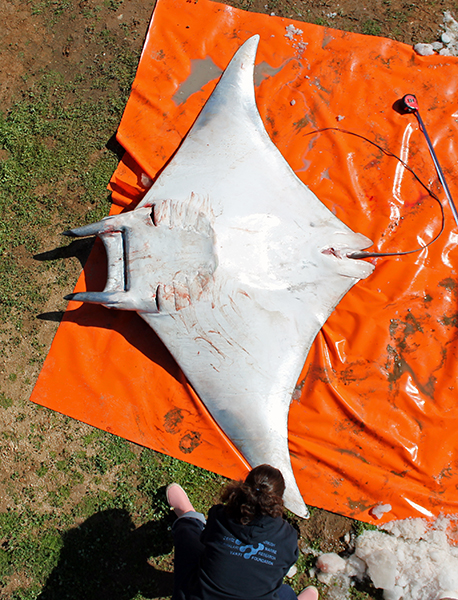


More about the Mobula species
The species belonging to the genus Mobula, called as Kulaklıfolya, Şeytanbalığı (Devilfish) and Manta in Turkish. They are oceanic and pelagic cartilaginous fish species found over the continental shelves. They exhibit ovoviparity (aplacental viviparity) and giving birth to only one or two pups per gestation period. They are in the “IUCN Red List of Threatened Species” and fishing, landing, display and trade are restricted by various international, regional, and national legislations.
Among them, CMS Appendix I & II (2014), European Union (2015), IATTC (2015), and CITES (2016) are the international protections that restricts fishing and/or trade of multiple species of the genus (Mobula spp.). Additionally, M. mobular is listed in GFCM (2015), Barcelona Convention SPA/BD Protocol Annex II (2001) and Bern Convention Appendix II (2001). Turkey is party to CITES and GFCM and the Barcelona and Bern Conventions.
More about TUDAV
Turkish Marine Research Foundation (TUDAV) is carrying out scientific studies in the Turkish seas for 20 years and the efforts to protect Turkey’s marine life and biological diversity is one of our top priorities. At the same time, TUDAV carries out long-term studies on stranded dead and wounded sea mammals and has signed joint projects with international organizations such as ACCOBAMS, UNEP, MedPAN and CIESM.
Project of the marine litter and cetacean strandings in the Turkish western Black Sea coast
İz Tv Boğazdaki Çöplük 3 – Geleceği Yaratanlar belgeselinden
TUDAV Leaving Marks in the Water 2007 Awards
Leaving Marks in the Water 2007’ awards were announced in the 16th of May in 2007 during the National Water Days 2007 Symposium which is organized by TUDAV and AKSAM ( Mediterranean Marine Products and Education Karadeniz Teknik University Sürmene Marine Science Faculty.
Prof. Dr. Mustafa Kuru
He is a lecturer in Başkent University. He is considered worthy for this 2007 award, owing to his studies on fish taxonomy as well as his studies which illuminates the next generations.
Press Release – Ross Sea
Documantation of the research cruise in 2007 to Romania (supported by TUDAV)
There hasn’t been any award given for 2006
There hasn’t been any award given for 2006
Press Release – Montreux Convention
15th Years video of our Foundation
TUDAV Leaving Marks in the Water 2005 Awards
‘Leaving Marks in the Water 2005’ awards were announced in the 29th of September in 2005 during the National Water Days 2005 Symposium which is organized by TUDAV and Karadeniz Teknik University Sürmene Marine Science Faculty.
Prof. Dr. Erol İZDAR
Establisher of Ege University Marine Science Institute
Press Release – BlackSeaWatch
SKYTURK
Vakıf Başkanımız Prof. Dr. Bayram Öztürk’ün 8 Kasım 2012 tarihinde katıldığı Skytürk kanalında yayınlanan Şimdi Söz Sizde programını aşağıdaki bağlantıdan seyredebilirsiniz.
TUDAV Leaving Marks in the Water 2004 Awards
‘Leaving Marks in the Water 2004’ awards were announced in the 6th of October in 2004 during the National Water Days 2004 Symposium which is organized by TUDAV and Dokuz Eylül University Marine Science and Technology Institute.
1. Ahmet Priştina (İzmir 1952-İzmir 2004)
Owing to his effective studies on preventing the Izmir Bay from pollution and clearing of it during his president of Izmir Metropolitan Municipility
2. Dr. Ülkü Merter-Şükrü Genç
Owing to provide the improvements on the institutional capacity related to the water pollution and water quality infrastructure in the Ministry of Agriculture
Press Release – Gökçeada Project
Black Sea Mouth of the Danube River
TUDAV Leaving Marks in the Water 2003 Awards
Leaving Marks in the Water 2003’ awards were announced in the 1th of October in 2003 during the National Water Days 2003 Symposium which is organized by TUDAV and Hacettepe University
1.Prof. Dr. Kazım Çeçen (Elazığ 1919-İstanbul 1997)
For his contribution to the Turkish Science History on his subject and for the techniques he developed on the removal of solid wastes of hydro-electrical facilities
2. Prof. Dr. Selçuk Soyupak
Owing to his global levels model studies on the eutrophication
3. Prof. Dr. Çağatay Güler
Owing to his work on the standardization of water and health topic as well as his studies which are on the implementation level
4. Nezih Bilecik
Owing to his affords on increasing the awareness on the marine organisms researches